Monday, September 23, 2013

Otto, Distinguished Mayor of Cat Town


Otto, beloved long-time cat companion and zen master, passed away at the age of 21, July 13th, 2013.  He had been with me for 19 years.  Kitten Otto had a rough start, being tossed in a plastic bag and put in a dumpster.  He was rescued by a person nameless to me, an acquaintance of a friend.  He lived briefly with his rescuer, then with my friend, and at the age of 2, became my first companion animal.

I had grown up without animals, as my mother was deathly afraid of them, and my father, raised initially on a farm, believed animals were meant to have room to roam, and shouldn't be in urban environments.  Mostly, I learned from my mother to be afraid.

But somehow, I was always drawn to cats, and at the age of 29, I felt compelled to offer this one refuge when I was asked.  It was a decision that changed my life forever.

Otto was the first of my animals.  It took some getting used to, an animal leaping upon my bed at all hours of the night and plunking himself down right by my head, sometimes expecting me to move to accommodate his desire for a specific spot.  My heart would palpitate, a remnant of the fear my mother had instilled in me, and the several bad experiences I had with neighbor dogs as a child.  But I was determined to bond with this animal in a deeper way than just finding his antics amusing.  I moved whatever limb he required, and tried to focus on his breathing and need to be near.

As a young cat, Otto had boundless energy.  We bought him small foam soccer balls and he delighted in kicking and chasing them all around the main room of our apartment.  He was quite skilled, and invented many interesting maneuvers in order to flip the balls into the air and get a second chance at walloping them with his back paws.  I enjoyed his joy, my first inkling that this creature had a sophisticated consciousness and a deep well of feelings.

About a year and a half after Otto moved in with us, we purchased our first home.  He made the transition very smoothly, perhaps a remnant of the many changes he experienced as a kitten.  As long as there was food and water in the bowls, a clean place to relieve himself, and the people he loved, Otto was easy-going.  At this time, we were gone long hours working, and we became concerned the cat was lonely.  Coincidentally, a coworker of my husband had two cats needing a home due to a new baby with severe allergies.  These cats were one year younger than Otto, a brother/sister duo that had also had an unusual beginning, born to a feral mom in someone's backyard.

I saw the photos, and took my husband's word for the sweetness of the one he'd met, and thus began the Otto, Critter, and Pippi years of our lives.


With other cats in the house, Otto revealed another facet of his personality: imperiousness.  A gracious imperiousness, but a definite authority.  He did not behave aggressively, yet there was a clear expression of being in charge.  That he was a tuxedo cat just lent an air of humor to this trait.  He had a particular need to monitor Pippi, the girl cat.  She was a tortie, very petite, and extremely affectionate.  She had no difficulty integrating herself into our lives.  From the first moment, she looked at you like, "Oh, you'll be feeding me now.  Good.  I love you."  At bedtime the first night in our home, she jumped up on my side and proceeded to wrap herself around my head and purr loudly.  Otto took his usual spot in between my husband and me.  He and Pippi didn't fight, but they seemed to have an understanding.  She believed herself to be Queen, and Otto did not officially recognize this, but also didn't mind that she maintained the delusion.  As long as behavior met his standards of decorum, he was very mellow.

Critter was another story.  A large polydactyl black cat, he hid under the sofa for the first three days.  Pippi went about her business as if Critter didn't even exist, but Otto seemed genuinely concerned.  He sat by the couch, waiting.

And once Critter did emerge, Otto was there as a companion and support.  They became the best of friends, grooming each other, playfully wrestling, and jostling over the best sunny spots for napping.  They truly seemed to love each other.


And so our lives went. 

Adding a baby into the mixture was interesting, to say the least.  Otto bonded with our daughter from day one.  He was a protector and mentor, and taught her lessons in compassion, duty, and graceful living.  I am eternally grateful to him, and to all our animals for providing experiences only they could.  No child should miss out on what animals have to offer our souls.


As I observed these three creatures I gained a deeper appreciation for each of them as individuals, but also as a sort of society of cats. They were my companions, but additionally involved in a complex relationship with each other.  They had their individual resting spots, their personal quirks, but they also seemed to dance together, Otto leading, Pippi with a commanding air, and Critter as a sort of Jester figure, providing comic relief.  He could scare himself silly with his own tail, and he literally jumped, like a cartoon cat, with all four limbs fully extended.  He slinked across the floor like Groucho Marx whenever the doorbell rang.  He also thought he was invisible if he just stood very still.

Pippi expected a chair to be provided for her at our table during all mealtimes.  If you forgot, she gently patted you on the hip with her delicate paw. 


Otto wanted the beds made and the floor swept every morning, first thing.  He monitored and supervised this activity.

Critter liked to sit on newspapers, and on the edge of the bathtub, sometimes very cautiously testing the water with his big paw.


Critter also loved Isis.  She was a long-haired cat that lived with us for too short a time.  She was a neighbor's cat that preferred our porch to her own, and when a dog joined her family, she refused to go home at all.  We took her in, but our animals, with the exception of Critter, did not.  Otto, Pippi, and Isis hissed and chased and marked their territories.  Critter tried to sit next to her, reaching out with that big, five-toed paw and petting her fluffy white tail.  Isis was not amused, and Critter always seemed saddened that he could not win her affection.


She died young, of a heart condition.  Her intense anxiety probably didn't help.  I felt so sad that we could not find a way to help all the animals get along with her.  But this is life.  It's not always smooth sailing, and at the end you can only rest knowing you did your best.

My animals taught me so many lessons.  Otto managed to live almost two years as an only, elderly cat.  He provided lessons in graceful aging in a way no person could.  He was diabetic, most likely near-blind, and you could tell his joints were stiff and achy.  Yet each day he went about his routine, never varying, always the optimist that food would appear, ice cubes would be had in the water dish, and occasionally even kicking around a soccer ball, playing with string, or chasing a laser.  He LOVED his stairs made by my daughter and husband to ease his burden.  He liked to sit on the back porch with us, observing the beautiful sunsets, and smelling the fresh air.  He greeted me at the door, no matter what hour I returned home.  And regardless of hearing loss, he never failed to appear when the refrigerator door opened. 


When his time came, he made sure we were all with him, patiently waiting for me to come home from work, greeting me with a look of imperiousness, as if to say "Where the hell have you been?"  He tried so hard to remain with us, a fighter until the end.

But that end did come.  Not a day goes by that I don't think of him.  Miss him.  Hope that he'll guide me somehow to another animal that will teach me more lessons I need to learn.

Farewell, Little Buddy, Honorable Mayor of Cat Town, the ever distinguished, Otto.

Namaste.


Celebrate Banned Books Week

Banned Books Week is just one of many ways a resident of Salt Lake City can acknowledge and celebrate the freedom to read.  This right, to choose books for oneself, without interference, judgment, or monitoring, is a fundamental principle upon which our public libraries are built.  Just by entering their branch, a stalwart local institution dedicated to civic space, library patrons stand in solidarity with all those who have come before and secured their right to move about freely, make their own choices, and attend to their own needs.  Reading a book of one’s choice is a statement in support of the Constitutional rights of all Americans.  

Reading is an intensely personal experience; the details informing our choices of material spring from an infinite variety of need and desire.   Reading can uplift our spirits, expose us to other people’s circumstances, increase our empathy, and enhance our reason.  In a complex, diverse society such as the United States, the ability to see through another’s eyes is critical for navigating the world on a day-to-day basis, and for the purpose of creating useful, effective public policy.  Free and uncensored access to books and information is vital for understanding our past, dealing with current conditions, and for building a better future.

Reading provides an opportunity for us all to experience the world more fully.  Through newspapers, magazines, comics, informational texts, and fiction, people of all ages can learn of life around the globe, across town, next door, and among our own.  We can learn of the past, imagine alternate worlds, strengthen our beliefs, and explore new ideas.   When we see ourselves in a fictional character, or a true-life tale, our significance increases.  For anyone feeling marginalized, whether an isolated stay-at-home parent, a teen dealing with a difficult family situation, a young person struggling with identity issues, refugees navigating an alien culture, or an elderly man or woman losing their sense of purpose, reading can provide both comfort and support.  Fiction connects us to our common humanity, and nonfiction provides inspiration and access to resources to improve our situation.  When our vision widens, our hearts and minds grow.  Books and reading make us feel less alone and thus more capable to solve problems and contribute to society.  Free access to reading materials is thus beneficial to individuals, to our community, and to the nation. 
 
Banned Books Week places focus on the perils of censorship.  Creating barriers or denying access to materials that may not be of use to us, but of great edification to our fellow readers is antithetical to the freedoms enshrined in the Bill of Rights.  If we wish our own freedom of choice to be respected, we must allow others the same, even if it means they choose something not to our taste or need.  We must also guard against monitoring access to materials, as this is a form of censorship.  Making something difficult to find, or requiring permission for use, are mechanisms of control that are unacceptable in a free society.    It may start with materials that have some element of controversy, but the question remains, where does it stop?  In a country as diverse as the United States, one can easily find differences of opinion.  Some people are against divorce.  Others may be against hunting for sport.  Should a library remove or restrict access to materials on these subjects if someone takes offense?  True choice does not involve removal of options.  Freedom of access is a fundamental corollary to the freedom to read.
Reading is one of the last unmediated activities left to us, commercial free, moving at our own pace, and requiring no special equipment beyond our own senses.  It is a critical and vital human activity; literacy is not simply a workplace skill, it is a life-building tool.  Choose to read.  Let others choose what they read.  Celebrate the freedom to read.  Support your public library and its mission to provide reading materials to all patrons equally.  

Read AND share what you read right here.   I'd love to hear what titles are most meaningful to you.

Friday, January 18, 2013

On Being Blunt, or What if it was me?

Yeah, I know.  I am blunt.  It gets me in trouble.  I don't care.  

I am blunt because I spent a childhood being mute about the abuse I suffered at the hands of an adult that was supposed to be my protector.  I am blunt now for all the years I spent thinking loud thoughts like "Why don't all you adults see what is right before your eyes! Do something, people with power and means!"  I am blunt now because I know being mute is an unacceptable response to the wrongs of the world.  I am blunt now as reparations for that lost childhood, and as a means to honor the humanity of all the wounded people I encounter. 

So, now I am going to be blunt about what it is like to be in a relationship with a person facing the daily trials of a chronic illness.  It is very difficult.  Everything I imagined for myself at 25, at 35, all the things I had worked hard to accomplish vanished in an instant with a diagnosis that took three long years, much medical trial and error, and several extended hospital stays to reach.  Savings disappeared in an instant, never possible to return.  Access to affordable health insurance became a driving force beyond measure.  Constant dealings with the health industrial complex dominate our days.

All those practicalities aside, I have to watch the person I love, the person I pledged to stand beside struggle with daily activities, yet getting up everyday and trying his best.  I am amazed at the strength of his character, his striving toward normalcy, and how hard he works to do what needs to be done.  I struggle with watching him be judged by people who never take one moment to imagine what it must be like to be him.  It is so frustrating to witness all the people he encounters in his daily personal war against illness who never have the common decency to ask "What can I do to help you stay engaged in meaningful activities and contributing to society?" Or to say "Thanks" for his accomplishments, large and small.

This is not to say I do not have many moments where my own thoughts are less than stellar.  I go through periods of fantasy where I imagine all sorts of scenarios whereby I do not have to deal with this any longer.  I get angry.  I feel tired.  I am depressed.  I judge him.  I once again wonder why no one sees me, sees that I, too, have a struggle to face each day.  It's like being that little kid again, everyday, pleading mutely with the world to make it stop. 

But, every day I blunt the self-pity with a simple question to myself, the one everyone should ask themselves one hundred times a day, whenever they encounter suffering:  What if it was me?

I am made better from this daily exercise.  I am not a martyr.  I am a fully realized human, with a life filled with joy and suffering, pleasure and pain, ups and downs.  I am committed to my ideals.  I will leave this place better for having been here.  And I will do my best not to be indifferent to the suffering of anyone, be they my partner or a stranger. 

Indifference to suffering is as bad as actively inflicting suffering.  When we retreat to the zero-sum game mentality we have been conditioned by all our modern institutions to live by, and think "thank god that wasn't me" or "that would never happen to me" or "I am superior," we are essentially stating loud and clear to the universe and everyone paying attention that we do not care about our fellow men.  It doesn't matter whether we label ourselves a liberal or a "compassionate" conservative.  Labels are words.  Words are not actions.  When we watch someone being kicked when they are down and we do nothing, thinking it best for self-preservation, or maybe even thinking, "well, they must deserve it" we are neither liberal nor compassionate.  "Nothing" is an action.  We are mean.  And mean people suck.  They suck the humanity out of everyone. 

We live in the meanest times I have ever encountered.  I honestly think if the Holocaust were happening today, unfolding just as it did before, there would be so much less resistance, so fewer hidden by those with means, no matter how meager.  Anne Frank would never have gotten to write her diary.  She'd have been dead the first day if some schmuck thought he'd get some extra cigarettes and a gold star for it.

So, for all you who have stood by the sidelines, never asking how we are, here's an update.  We are in need of support.  We live in a time of instant and easy communication.  An email, a text, a note with a "forever"-unbelievably-cheap stamp on it, or a phone call can make our day.  Our little girl could use some reassurance that the world is not filled entirely with self-glorifying, self-serving jerks and a general populace scared witless, silent, and indifferent by the former. 

And "yes" is the answer to the question "Am I my brother's keeper?" in case you didn't get the memo.

Saturday, December 29, 2012

On the Processing of Grief

My father passed away one year ago.  Traditionally, Jews honor a year of mourning; modern secular therapists say the same.  It takes a year. 

Contrary to this traditional framing of the process, I believe my meditation on loss and grief has just commenced. I am only beginning to understand who my father truly was, what role he played in shaping who I am, and his impact upon all who happened upon his journey. 

In the cataloging of all the evidence of his existence, itemizing every drawer, every closet, every box, his story has become so much more muddled than I ever thought possible.  I always thought I knew him well.  We were very close; we spoke often, and mused together deeply.  I felt clear on what traits we shared, which ones I hoped not to carry on through the passing of time, and those I wished I had.  In my middle age and in the time of his death, his story now alternates between being one of amazing perseverance and that of a cautionary tale of the shadowy power of ideals. 

Dad was a philosopher.  As a very small child, I remember him saying to me, with the kindest of instructive tone, "What if everyone did it?"  Only later did I realize he was instilling in me Kant's Categorical Imperative.  He could quote verbatim all sorts of learned texts, but always managed to present his ideals in common man terms.  He believed work was good for our souls, and always encouraged me to find an occupation that was both fulfilling to me and uplifting to others.  Although we differed as to what he thought I should do with my life, I know that part of why I earn my living as I do is because of seeds he planted. 

He was an exquisite violinist, and my childhood was filled with live music.  He practiced endless hours; I had a special chair of my own in his room, where I curled up and read while he played the violin.  Every night, he'd play recordings of his favorite violin concertos or my favorite ballets, petting my head as one would a cat, until I was sleeping, a state I had trouble realizing on my own.  To this day, I cannot hear certain violin concertos without my mind bifurcating in a very odd way: I hear both the music I am listening to in real time and my father playing in my memory, all the while making note of phrasing, emotive, and stylistic differences. 

It has been through music that I have grieved the most obviously.  Certain concertos simply cannot be listened to without tears, both of loss and of appreciation for filling my heart and mind with the beauty of Bach, Mendelssohn, Brahms, and all the rest. 

Dad's sentimentality was monumental.  In clearing out the house in which he had lived for 55 years, I uncovered endless boxes of what mostly appeared to be detritus, when suddenly I'd recognize something.  A piece of charred wood from the first bonfire I had made myself.  The number I wore at the audition where I had won the coveted role of Clara in The Nutcracker.   Stones like those we skipped at the pond on my grandfather's farm.  He kept every letter ever sent to him, the hospital bills for the birth of this children, notes I'd left him as a small child. 

But above all else, Dad was almost child-like in his belief in people.  He had so much compassion he quite often ignored the negative, as if it would simply go away if we just gave it no attention.  He actually would say "we'll not dwell on that" and then expect you to let things go, just like that.  Just like he did.  It was both inspiring and maddening.  He was so powered by wishful thinking he often could not recognize the havoc wreaked by all the wounded creatures he ministered to and dedicated his life to saving.  I both admired his ability to accept and forgive, and raged against his expectation of me to be superhuman like him. 

And expect he did.  I will never understand why his expectations of me were clearly different than that of others in his life.  Perhaps he saw his own face so reflected in mine, he imagined we were also alike inside.  Or maybe he saw me as fulfilling his own dreams, which had been so thwarted by poverty, the Great Depression, World War II, and a difficult family.  

He had a gentle, quiet demeanor, though he was quick to laugh and see the absurdity of things.  He was kind to a fault.  But he was strictly guarded emotionally, and rarely shared personal feelings. He was intensely private.  He never said "I love you"; I have to assume he believed it was unnecessary.  And he expected me to behave just as he did.  He seemed disappointed when I insisted on talking about my feelings. 

But in the end, he left me things to find among all that sentimental detritus that filled in some of those emotional gaps, as if he knew I was right in asking the questions he was uncomfortable answering.  I just wish he had had the courage to talk about such things when he was alive.  He counseled often of the impact of hubris; he was an admirer of Hadrian, an emperor who once said "To be right too soon is to be wrong."  I'm not sure if he saw the impact of his own hubris, or whether he thought time would forgive his choices.  Either way, I'm sure he believed he was implanting those ideas into my thought process for a reason.

I will pass on many of the truths my father taught me.  He was a good man, with a kind heart, and big ideas.  I will share his legacy by telling my daughter how I came to these truths, and what experiences I had that brought me to such conclusions, in the hope that she will really understand who I am before I am gone.  Although I am sure we all keep a part of ourselves hidden from the world, I think it cheapens the value of our experiences, lessens the impact of our story, and keeps us from truly communing with those we love.  We are all fragile creatures, even the ones who seem the strongest. 

I am so grateful for my father's endurance, and only wish he would have shared his inner burdens so I could have understood him more deeply before he was gone.

I will be reflecting on him for as long as I live; I can only hope the feelings of sadness and grief will someday subside. 

I think it takes more than a year, tradition be damned.


Sunday, December 16, 2012

Truth, Honesty, and Empathy

Several days have passed since the shootings in Newtown, Connecticut.  Many more tragedies have befallen the world's people in that time.  All the timeless terrors of human life - war, hunger, illness, poverty, homelessness, addiction, natural disasters, accidents, to name but a few - have visited and left devastation in their wake.  Life is struggle.  Life is suffering.  Without struggle and suffering, we would not know triumph and joy.  This does not make struggle and suffering any easier to bear.

But all humans struggle and suffer in some capacity, including children.  They are not of some other existence.  This sort of "innocence" is an adult fantasy.  Experience begins with the first breath, a struggle to leave the amniotic world and enter an entirely different environment.  Children are not unaware of the world and the struggle to survive.  They just have less experience.

After reading numerous posts and articles regarding "what to tell the children" I have come to realize I am of a somewhat minority opinion on this topic.  I believe attempting to hide the world is tantamount to lying to your child.  If you believe attachment comes from a place of trust, lying is not permissible. 

Kids live in the same world adults do, but they need some assistance with navigation.  And when navigating terrain as complex as human society, it's so much better to be aware of obstacles than oblivious. 

The problems of our human culture are enormous.  Ossified institutions, technocratic leadership, alienating technology, and the greed, war, poverty, and illness they encourage are not things easily hidden.  The triumphs of human culture are also enormous.  Good things exist and happen, too.  They are also not easily hidden.  Reality is messy, but humans cannot escape it, including the young.  


I believe children are learning to navigate reality, and this is a journey they will continue throughout their lives.  Reality doesn't always seem friendly or safe, but it is what it is.  Humans do not have omnipotence, but we do have consciousness.  It is our moral obligation to develop this consciousness by inculcating empathy in our children and ourselves.  They cannot practice empathy if they are unaware of human suffering.  If they do not practice empathy from their earliest memory, it will not gain the traction it needs to root itself in their very core. 


To understand that life is fragile, and that bad things happen to good people, is not inherently frightening if this view is developed with the love and support of family and friends.  One of the memes that has circulated heavily this weekend is Mr Rogers remembering his mother telling him to "look for the helpers" when he was frightened by news of terrible events.  This is precisely what I mean.  If from an early age, humans learn that their experiences are not happening in a vacuum, that others like themselves have faced what they face, and they can turn to others, the helpers, when in need, there would be so much less fear, loneliness, depression, desperation, and anger, and problems would not escalate so quickly and violently. 

We must raise our children to be part of something bigger than themselves, expressing their individual gifts as a contributor, a helper, a builder, instead of as atomized individuals, alone, in constant competition for material success and favor.  They must understand the relativity of their position, that we are all equal in rights but not in social privilege or natural gifts, and thus we must always consider the least of us in our ideas and actions. 


Another important point must be made in light of the current tragedy instigating discussion:   We must not demonize mental illness.  By calling people "evil" we fail to address the human-created system that bred and/or failed to help them.   We cannot presume anyone, including our own children, won't ever suffer from a mental illness or significant form of stress.  If they see such illness or stress as a stigma, they too may be reluctant to get the help they need, and the system of ensured failure perpetuates itself.   

Life is about choices, though we don't often get all the options we'd like to have.  We must show our children there are always other humans to turn to for help, and children will do so if they have been raised to see others as compatriots, not competitors. We must look at all our institutions and notice how they work against cooperation, and give privilege to extreme competition, to the point where we lose our humanity and begin to take out competitors through violence.  


This is the 15th mass shooting in the US this year.  Parents who think their children know nothing of this type of occurrence appear delusional, and are likely to have diminished credibility as their children grow older.  We adults need to stop appearing delusional or our children will never trust us to help them.


As someone who favors Buddhist and existential philosophy, and having dealt with human and companion animal deaths, chronic illness, and aging friends and family, I have always emphasized to my daughter our mortality and the fleeting nature of life.  Maybe this is what makes my minority perspective feel natural.  Maybe it's because I have had these conversations with my daughter for as long as bad things have been happening, which is since, well, always.  Kids are human.  They have the same types of feelings adults have, they just have less experience to filter them through, so their expressions are different. 


All this said, I don't think you have to inundate a child with tragedy, just acknowledge it.  Talk honestly about your own feelings.  Use reason and logic to remind them that, mostly, we muddle along safely.  If we get sick, we mostly get better.  If we get hurt, we mostly heal.  But sometimes we don't.  Don't promise something you know to be false.  J
ust note that in all these circumstances, there are always helpers, people who are caring, helpful, and kind.

Remind them of all the history your ancestral family has experienced, yet here we are.   This is how to develop reverence.  Go outside, look at the beauty of the natural world, and then say thanks to all who have come before you and endured, so you, too, are privileged to see a mountain, the starry sky, a sunset, or a flower.  Be thankful for every day, starting with the first breath.  It's never too early to be grateful.  It's never too early to learn to be kind, for we know not what battles each person faces.  Help exists because there is always need.  We extend our hand, and in turn, someone extends a hand to us.  

Even the tiniest of children go through "helping" stages.  Encourage them to look for ways to help, and they can't avoid noticing need.  Needs that go unnoticed cause tragedy.  We must all notice and help more, and we can't do this if we are busy hiding things.  

Monday, May 30, 2011

Setting Differences Aside


In the twilight of their lives, a moment at ease, differences set aside.  We should all be so magnanimous, even if only to experience a transitory, momentary sensation of peace.

These two cats have endured a 16-year spat.  The rivalry intensified when their companion, Cat #3, passed away several years ago.  On most days, they must have several feet between them at dinner time.   But once, months ago, the extraordinary occurred.

It was beautiful, poignant, and sweet.

Tonight my child shed tears over how quickly her carefree years are passing.  Time waits for no one, not even the young.  We must savor every moment, even those that seem bitter, sour, or as salt in our wounds. 

Why do we spend so much time seeing what's wrong, what's imperfect, what annoys, and what irritates? 

Before we can repair the world and ourselves, we have to see what is good, and know it in our hearts.  Now is the time to take in the beauty, joy and mystery of life.  Now is always the time to create a better today.  Now is ever present.  Time is all we have.

These may seem platitudes, but there's no arguing with aging, or with the truth that we shall all die someday.

All creatures suffer.  Soften that suffering with love and compassion.  And maybe, every so often, share a meal with your nemesis.  Put your differences aside, and be together as companions on a strange voyage.


Thursday, January 27, 2011

Remind Me, What Game Are We Playing?

For several days, I have been fixated on the phrases "race to the top" and "win the future."  I've been pondering how little these phrases resonate for me, how absolutely dissonant they are with my personal life experience.  How is this top defined?  What do you do when you reach it?  Who gives or receives the high-five?  What happens to the losers of the race?  Why do we not want everyone to reach this imaginary peak?

And, once we arrive at this metaphorical top, where else is there to go, except down?

First phrase questioned, now for the second.  How do you win an abstract, noncount noun?  Is this a compulsory round, or do we have a choice whether or not to participate in the future game?   Again, if there are winners, there must be losers.  Does time stop for losers, and no future manifests itself in the space-time continuum?  The mathematics and physics of future-winning must be extremely advanced. 

Frankly, "winning the future" is a totally nonsensical phrase.  I still can't get over its repetition, or that it was supposed to be inspiring.

Imagining life to be a game is an insidious concept.  It undermines our ability to take seriously the work of creating a livable, sustainable, compassionate, and cooperative world.  Game is another word for competition.  Competition, by definition requires adversaries, winners, and losers.  Depending upon the nature of the competition, friendly or cut-throat, winning at any cost is a possibility.  Doing what it takes comes into play.  Advantages are sought.  Cheating may occur.  Chance might be involved, or handicaps awarded. 

Is life a shell game, zero-sum game, fair game, or the only game in town?  Who establishes the rules of the game?  Is it a game of skill?  A gamble?  Will there be bluffs?  Is it a long shot?

Metaphor is a useful story-teller's tool.  It can elucidate an idea and capture the spirit of an abstraction, reducing complex notions to digestible nuggets.  But the Game of Life metaphor works mainly in the context of literature, and is not best used to organize the nation's efforts to lift people from poverty, build infrastructure, and educate our populace. 

Play is a useful tool in the development of creativity and problem-solving skills.  But life is not all play.  When children go hungry, families are homeless, bridges collapse, illiteracy and innumeracy reign supreme, and endless wars absorb all the hard work of a nation, playing a game is not the answer.  I think we've already won the race to nowhere.


Wednesday, December 29, 2010

Goodbye, 2010!

This has been a remarkably difficult year.  It began with a flooded basement and the death of my mother, continued with multiple home repairs and car failures, and concluded with a wild night at Small Claims Court, worry about my elderly father, and a workplace restructure.  All the while, we have been surrounded by an America filled with the discontented, the anxious, and the mad. 

Through the trials and tribulations, our family has attempted to maintain a sense of humor.  Perspective has been discussed frequently.  This too shall pass, uttered often.  Gratitude, for what we have, for friends and unconditional love, has been expressed.

But, the most satisfying moments have been those of action.  Things pass not only due to the relentless pace of time, but through thoughtful words and deeds.  Fear is a paralyzing tool, and as thus it is used to disable victims of the power-hungry, the greedy, and the bully.   When we fail to speak or act, we betray not only ourselves but others.  Sometimes you can simply wait out conditions, and all will be well.  Much of our lives is spent this way, as we cannot control our most immediate circumstances, the chance of our birth, the actions of others, the weather.  But sometimes a catalyst is necessary, a shove, a nudge, a spark, to redirect energy.

May you be a catalyst in 2011, and actively refresh the possibilities of a better and more positive future.

Thursday, October 14, 2010

Summertime, and the Living was Busy

From my last post, to the beginning of Autumn 2010, we filled our days with adventure and exploration.  From familiar ground, like Red Butte Garden, to totally new experiences, like being on a movie set, the pace of life has been brisk.

Red Butte Garden, August 2010


Maya had the good fortune to be cast in a film shot here over the month of August.  She had four days on set, including two back-to-back shoots, so our family stayed overnight in the Cast House, affectionately known as "The Mabin" (as in Mansion Cabin).  It was a wonderful experience for us all.

The "Mabin" Basement Dressing Room
The film is a new version of Hansel and Gretel.  Maya plays the Witch, Gertrude, as a child.  Naturally, bad things happen to Child Gertrude, giving her a back story, and the fairy tale greater narrative depth.  I couldn't have asked for a more perfect first film experience for my daughter.  The crew and cast were marvelous, the settings glorious, the weather perfect, and the role challenging.  Can't wait for the premiere!

The Woods
The River

Getting Direction
Setting the Scene at Gertrude's House
My Beautiful Daughter in her First Feature Film
As if this did not keep us busy enough, Maya also managed to volunteer Saturdays at Ten Thousand Villages, began a new session at Ballet West Academy, started Comedy Acting class at the Children's Theatre, finished Suzuki Violin Book II, and learned to play Beethoven's Ode to Joy on a ukelele. 


For a little rest and relaxation, we traveled first to Antelope Island, and then to Torrey, Utah, where we visited Capitol Reef National Park.
It's like another world, only 40 minutes away, and 9 miles across a causeway.

Symbiosis

My Family


And now we're ready to soar into Autumn, 2010.

Thursday, July 29, 2010

Renegade Absurdist


This summer we have celebrated the absurdity of modern life by making and sharing much DaDa poetry.

I furiously refilled my trusted DaDa box with massive amounts of clippings.  Maya needed supplies for a Community Writing Center kids' poetry workshop she co-lead during the Utah Arts Festival.  Editing the news with scissors is most pleasurable.

The Arts Festival is a four-day event, with something for everyone.  Maya has performed several years with Children's Dance Theatre.

Being in the spotlight is in her blood.  She definitely came here to be seen and heard.  Dance is one form of self-expression at which she excels.

Shouldn't everyone be seen and heard?

Each mind is unique, every perspective shaded from a different reference point.  If more people felt comfortable expressing themselves, we would all be richer.

Writing is another form of self-expression and communication that Maya enjoys.  She makes poems, writes short stories, picture books, cartoons, novels, and does a little blogging.  Organizations like the Community Writing Center provide a wonderful service to the people of SLC, and give kids like Maya an opportunity to share their passion with others.  We are both very happy to volunteer with them.  This year she did the DaDa Poetry workshop, and I lead a discussion with parents about incorporating writing into a family's life.

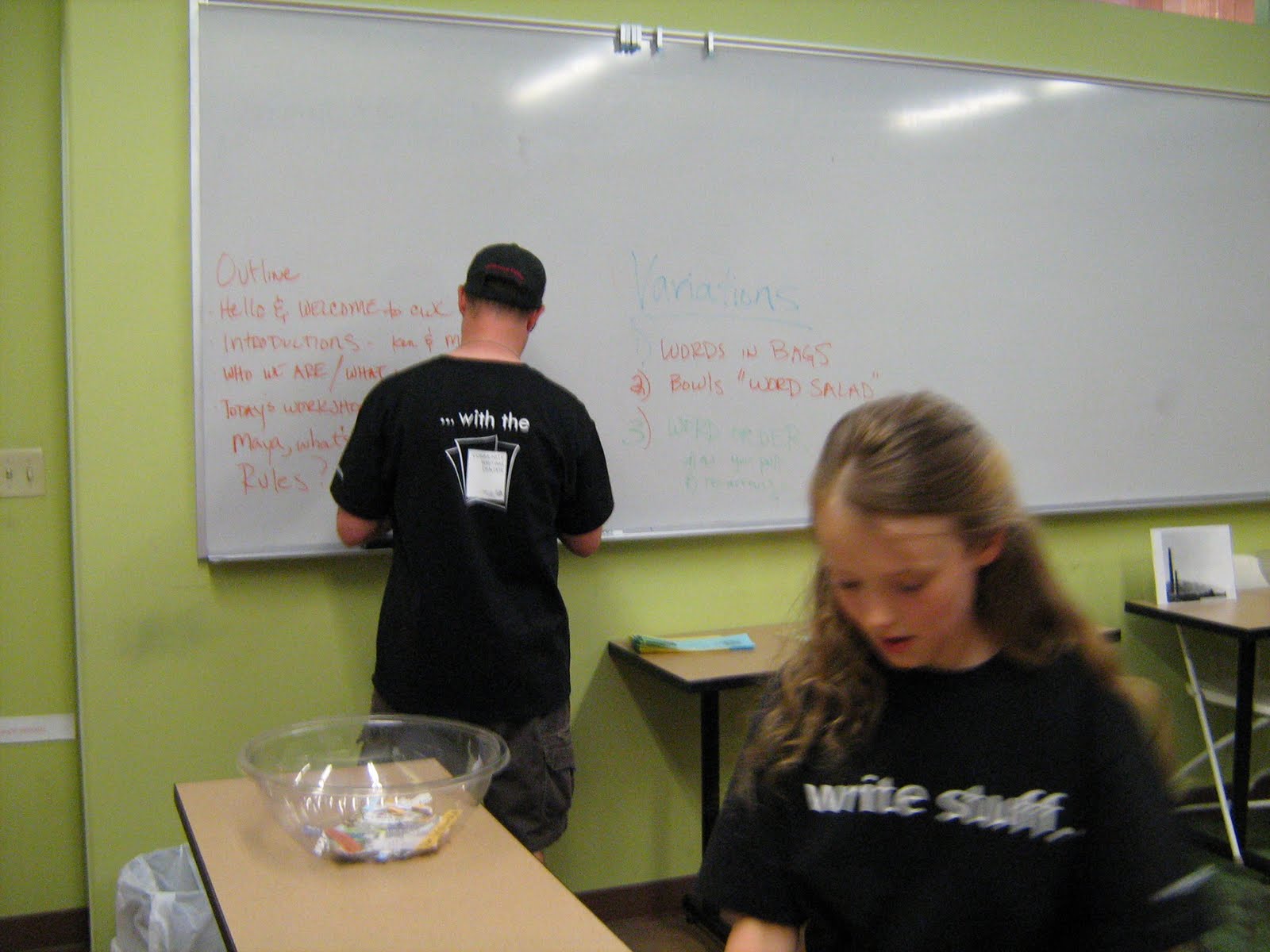
Here is a photo essay of the preparation Maya and her fellow CWC volunteer Ken did for the workshop:

Word Salad in the making!
Warming up with words
Rules?  NO RULES!

Write stuff, indeed.

A couple of weeks later, I participated in the Second Annual Utah Alternative Press Festival.  Brought my word casserole to the Main Library, and manned a table for the CWC.  Many random people made many random poems.  Little kids, homeless folks, hipsters, friends, and frenemies all united to decorate our area with spontaneous art.  One older gentleman who was initially reluctant to participate, and certain he would get nothing but nonsense, got so absorbed by the project he pulled up a chair to the middle of our small table and proceeded to work on his creation for a solid 45 minutes.  Then he read it aloud.  Again and again.  He went away.  He came back.  He read the poem aloud again.  A few people purposely returned with companions.  Photos were made.  Poems were left, poems were carried away. 

More than a few people asked, incredulously, "I just want to know who cut out all this stuff!?!" 

That would be me.

It's just another form of smashing things down to start something new.

Reduce (the power), Recycle (engage your creativity), Reuse (there is nothing new under the sun, except you.  Stand on your head sometimes.  Same stuff, different perspective).  

And if you haven't already done so, race to your local library and share in "Mimi's DaDa Catifesto" by Shelley Jackson (you probably thought I wasn't going to mention that!).  It's delicious!

Wednesday, June 30, 2010

The Golden Rule, From Atop a Great Big Soapbox

This morning I woke up feeling particularly sensitive to absurdity.  I apply my "doing is becoming" philosophy to all, as once you see significance in anything, you see it in everything.  The first few news stories I reflected upon today made me climb atop a great big soapbox.  Here's the result:

When you hear the phrase "new normal," you should realize you and your family are being sold lies based on fear and private greed.  It's your money.  It's your quality of life.  If you held the actual cash in your hand, how would you spend it?  Would you continue to kill children whose only crime was to be born in the wrong place at the wrong time?  Would you continue to send your neighbors' children into harm's way to intervene in a power struggle, or fight against tribal people, thousands of miles away from your home?  Would you give it all and promise more to the fattest guy in the biggest house at the end of the street?  Or would you provide clean water, food, clothing, medicine, housing, jobs, libraries, art, learning opportunities (insert what makes your life meaningful and livable here) to yourself and your immediate family?

What you would provide to your family is what you should extend to the collective family of humanity.  It's very simple.  It's the basic rule of every spiritual and ethical tradition known to mankind.  This rule doesn't specify "others whom are just like you."  It says very plainly and clearly, "Do unto others, as you would have others do unto you."  Just plain "others."  All others, no exceptions.

Why do you give up agency just because the dollars flow unseen from your electronic paycheck to a paid representative of the people and a treasurer far away?  Why do you let them scare you with their tales of woe?  Why do you believe the world will end if we don't do as legislatures and corporations say we must?  If they got us into this mess by misspending our money, why do we trust them with the solution?  In a democratic republic, it is the hired (elected) person's duty to be responsive to their constituents' actual needs, not to sell their version of reality to us and collect their fee.  Stop listening to opinion makers, and start reflecting and crafting your own ideas.  Share those ideas with others, especially your paid representative.  If they are unresponsive, vote them out of office.  It's a beautifully simple system.  All it requires is that you author your own life.  Care.  Share.  Act.  Cooperate and collaborate to build a livable world.  You will be enriched by it personally, and the globe will be a lot more welcoming.

So take a few minutes to reflect:

How many of us wake up each day and say we need to drop a bomb on someone to keep going?

How many of us wake up and say "I must eat"?

The answers are so obvious when you drop the news cycle rhetoric.

What are your actual needs?  Do you think there is a person on earth whose real human needs are any different?

Humans are storytellers by nature, always seeing meaning, but sometimes we forget who's telling the tale.  You are accountable for the narrative you live.  Choose well.

Monday, June 21, 2010

Lessons in Compassion

Maya began attending theater camp last week.  It runs 6 1/2 hours per weekday, with an hour lunch break included.  While she has had many busy days filled with multiple activities in her nine years, including several half-day camps, and even a one-week, all-day split location camp last summer, this is probably the most "school-like" environment she has ever experienced.

Long hours.  No control over the timing of breaks.  The randomness of classmates.  Running from one building to the next, with little time to spare.  The "3 strikes" method of discipline.  Crankiness setting in by the end of the day.  Homework when you have rehearsals in the evening.

Compassion is something I am hard at work on deepening in myself.  I am always trying to feel more for the general human experience.  As a parent, it is natural to aid your child's development of empathy.  After her first comment about the length of the day, I noted she only had to do this for three weeks.  Most kids do this all year long.  Some have even longer days, with before and after school care.

This, it seems, really made her pause.

She continues to talk about it.

For three years Maya has been attending a multiplicity of "after-school" programs, like ballet lessons, acting, and modern dance.  She is a very serious student, with laser-like focus on the task at hand.  While she enjoys meeting kids, and making friends that share interests, she doesn't like to socialize during class. 

After class, she has endless tales of woe regarding the demeanor of some of the students.  "They won't listen."  "They try to talk to me while I'm listening."  "They have to go to the bathroom all the time."  Analysis ensues.  "Why do YOU think these students behave this way?" I ask.  We have endless conversations about kids not having much power, parents who mean well, but perhaps don't choose activities that best suit the child, family problems, and what it's like to be powerless and maybe a little bored all day long.

Maya has always seemed to grasp the point of these conversations:  Everyone has a story.  Every story has an internal logic.  Internal logic is not always in tune with external logic, as it is part of a narrative told from only one perspective. Unless we know someone very well, we are only witnessing the actions of the tale, not the motivations.

Sometimes to amuse ourselves, but also as an exercise in empathy, we create stories for all the poor drivers on the road.  Sometimes they are bathroom related.  Other times they are tales of woe, like the death of pets, driving home from a funeral, or going to a hospital.  Maybe they are so excited to see a loved one after a long separation they JUST CAN'T WAIT TO GET THERE!

But somehow, after all these talks, all these mental exercises, I think at age 9 Maya is really finally internalizing this empathetic process.  She honestly feels deeply for the unique circumstances of her peers at theater camp.

Conversely, she is also coming to understand how extraordinary our ordinary family's choices are.  She's the only one in this particular peer group who doesn't share a narrative. That story powerfully shapes who these kids will become.  Will they continue to be reactive?  Will they become passive-aggressive?  Or just plain passive or aggressive?  Hyper-competitive?  How many will use this daily, year-after-year experience as a springboard to authenticity, true authorship of their narrative?

Maya is learning that as a family, we may at times have limited funds, limited experience, limited knowledge, and limited power, but we have limitless dreams, fearlessness, and creativity.  We believe we can always rewrite the narrative of our lives to avoid overwhelming powerlessness and to stave off boredom.  Many people continue to see our home schooling as swimming upstream, a Quixotic adventure.  But to me, impossible is just a degree of difficulty.  I hope those kids that feel they face the impossible each day will find their true voices and sing.

Wednesday, June 16, 2010

Hard Work, Creativity, & Generosity

As Spring sprung forth, the frenzy of activity in our family's life reached yet another peak.

Maya had many rehearsals for Ballet West Academy's Spring production.  It was a splendid three-day run, with many impressive performances by dancers ages 8-20.  I am always heartened when teachers allow children to reach beyond expectation.  The level of technique demonstrated by these students was tremendous, and I felt honored to be in the audience, as the experience was authentically breath-taking.  Not something generally said about a school recital, but repeated by everyone I talked to who had attended. 


After a long week of late nights at the theater, a dip in our friend's neighborhood pool was delightful.  We are fortunate to be part of the Carlson "surrogate" family. 


Chad and I celebrated our 20th wedding anniversary in Idaho, courtesy of another set of amazingly generous friends.

Maya was so excited to sleep in a loft!

We biked around Redfish Lake, and enjoyed the stunning scenery.


Peaceful moments are great gifts to young and old alike.  Though we could have used this visit to Idaho to reinforce factual concepts learned through our home school, this time we took an opportunity to quietly contemplate.  Here and there I may have directed notice to an interesting rock, mass of moss, cloud, or sap-exuding tree, but no quizzing ensued.  As an always-learning, always-teaching sort of person, sometimes it's hard for me to be still mentally (and physically).  But it was easy in Idaho.

I'm not a trained birder, but I am very interested in these descendants of dinosaurs.  Ravens and crows seem to follow us wherever we go, often making me think of Native American spirit animal tales.  Idaho was no exception to this recurring experience.  But this time we also were visited by 3 ospreys.  The birds were taking advantage of easy prey at a fish hatchery pond.  Watching the ospreys dive into the water was breathtaking.  Listening to them communicate with one another was fascinating, as well.


A bald eagle also flew overhead and circled for a bit, but was too high for my camera to capture adequately.

Maya wanted to learn about fishing, so Chad put on his grandpa's fishing outfit, got out the antique gear, and gave it a whirl.

Maya was terribly concerned about not hurting the fish, and also about what sort of bait to use.  Being a life-long vegan, it's difficult for her to avoid thinking about such matters, which is a good thing, but I've always encouraged her to follow what her heart tells her.  I personally think the most important ethical act a human can perform is truly conscious decision-making.

In our historical studies, Maya has learned much about the impact of the environment on culture, and how in contemporary times we sometimes forget how tied to the land people have mostly been.  I thought it was good for her to experience this primeval activity, to develop greater empathy for our ancestors and for those on earth now with limited mobility and opportunity.  And, of course, she could catch and release! 


Namaste, little fish.  Thank you for helping my daughter learn.  And good work, Chad, at helping Maya release so quickly!  Boy, did that fish swim fast!